
The Guardian
How will the three promoted teams fare in the Premier League?
14. August 2026

Ryan Giles celebrates Hull’s promotion; Coventry players look steely; Marcelino Núñez shone for Ipswich after leaving Norwich (clockwise from top left). Composite: Getty, Rex Features
How will the three promoted teams fare in the Premier League?
Sunderland and Leeds defied the odds and stayed up last season. Will Coventry, Hull and Ipswich continue the trend?
Coventry
A quarter of a century after their last appearance in the Premier League – following financial ruin, ground-sharing in Northampton and Birmingham and even a spell in League Two – Coventry have finally completed their comeback story. But the bunting has been packed away and they now face the daunting task of proving they belong in the top flight.
Frank Lampard is not starting from scratch. Coventry’s success last season was a collective effort and a product of smart recruitment over the past few years. The result was a side that overwhelmed the Championship with a fearless front-footed approach without relying on a single scorer. Seven Coventry players scored seven or more league goals.
They led the division for shots on target; they ranked second for big chances created, touches in the opposition’s final third and touches in the penalty area; and they produced direct attacking speed and passes-per-sequence numbers comparable to those of some of the Premier League’s most direct sides, including Brentford and Bournemouth.
The title was wrapped up with three games to spare; they conceded the fewest goals in the division (45 in 46 games); and their 97-goal haul was the fourth highest in a 46-game Championship season, behind only Fulham in 2021–22, Bournemouth in 2014–15 and Reading in 2005–06. Given the success Fulham and Bournemouth have enjoyed in recent years, Coventry will hope that proves a good omen.
Continuity is going to be central to their hopes of survival. They are not following in the footsteps of Sunderland, who spent about £155m last summer. Coventry’s net spend was about £3.5m last summer and just 17% of minutes on the pitch last season went to newcomers. Their best business in the transfer window was holding on to players such as Jack Rudoni and Milan van Ewijk, who were attracting interest from top-flight clubs.
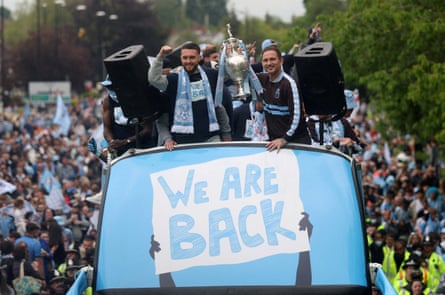
Coventry’s captain, Matt Grimes, and manager, Frank Lampard enjoy the Championship parade. Now comes the hard part. Photograph: Hannah McKay/Reuters
They have not gone wild this summer but they have invested. Coventry have signed the centre-back Aurèle Amenda from Eintracht Frankfurt, the winger Loum Tchaouna from Burnley, and the midfielder Caleb Yirenkyi from Nordsjælland while also securing permanent deals for Frank Onyeka and Carl Rushworth, who were on loan at the club last season. They have also brought back the former favourite Gustavo Hamer after his spell at Sheffield United.
Lampard’s biggest challenge will be adapting a style built to dominate in the Championship into one capable of surviving the Premier League. Their direct, attacking approach will be riskier against opponents who possess the pace, quality and tactical sophistication to punish a rushed pass or a risky vertical ball.
Coventry will not have the same territorial control or volume of chances they enjoyed last season either – they need players who can get them up the pitch. Haji Wright’s pace and ability to attack space should be valuable, but Ellis Simms, who tends to thrive attacking the penalty area, will need service.
Hull
The fact Hull are playing in the Premier League this season borders on miraculous. This is a side that survived relegation to League One on goal difference the season before last, entered 2025-26 under a transfer embargo, scraped into the playoffs by beating Norwich on the final day of the season, and scored a stoppage-time winner in the playoff final. No one backed them in their pre-season predictions and yet, under the guidance of the relatively unknown Sergej Jakirovic in his first season in charge, they defied the statistics.
If matches in the Championship last season had been decided by expected goals, Hull would have finished second bottom. The glaringly obvious problem was at the back. They conceded 66 goals, giving them the fourth worst defensive record in the Championship. Looking back at the last 15 teams to be promoted to the Premier League, only Southampton (who conceded 63 goals when they were promoted in 2023-24) have come close to that tally and they went on to concede 86 goals in the top flight, finishing rock bottom with just 12 points.
As if that weren’t bad enough, Hull were lucky to not concede more: opponents failed to convert 10 opportunities where they had at least a 50% chance of scoring according to xG – the most of any side in the league. Hull simply have to improve as fortune does not tend to stick around long when you’re in the Premier League.
There are some reasons for optimism, though. Their form against the top teams in away matches was impressive. They conceded just eight goals in their matches at the teams in the top 10; they did not concede in either of their games against Coventry; and they didn’t concede in any of their playoff matches.

Hull City players celebrate reaching the Premier League with a victory parade. Photograph: Bruce Rollinson/PA
Jakirovic showed an impressive knack of switching tactics depending on whom his side faced or how a game was evolving. His switch from their usual 4-2-3-1 formation to a back three with wingbacks in the second leg of their playoff tie against Millwall was perhaps the most telling example of this succeeding as they caught Millwall by surprise, winning 2-0 at the Den. If continuity is the key word in Coventry’s fight for survival then chaos seems to be Hull’s. You don’t really know what to expect from them. The striker Oli McBurnie pointed this out last season: “It’s probably hard to gameplan against us, because we play so many different ways against different teams.”
As well as their unpredictability, this team have heart. They defied all expectations to reach the top, overcoming a relegation battle, a transfer embargo and statistical odds. Jakirovic put their success down to the bond they have forged. “It was like a puzzle,” he said. “Maybe it was the best that it happened like this. This group of players became even closer. They had to stick together and help each other.” As Robert Earnshaw, who played for Derby in their disastrous 2007-08 campaign, has warned: “You can relegate yourself based on how you think. It was almost as if everyone gave up. It was 20 games to go and it was like: ‘We’re never going to do it.’” This Hull side have fight and that should count for something.
Ipswich
Two years ago Ipswich entered the Premier League as one of football’s feelgood stories. After they had had 22 years away from the top flight, Kieran McKenna took them back through back-to-back promotions, turning a squad largely built for League One into Championship contenders. The 2023-24 campaign was fuelled by fearless, attacking football, late goals and a sense of togetherness, with Ipswich finishing second behind Leicester and becoming the first side in 12 years to climb from League One to the Premier League in successive seasons.
McKenna’s side had an established core who had grown together and exceeded expectations but they were small fish in a very big pond, and the Premier League quickly exposed the gulf in quality. Ipswich won just four games, conceded 82 times and finished 19th with 22 points. Their immediate return to the top flight, fuelled by Premier League experience and parachute payments, means this is a very different promotion story – less about underdogs defying expectations and more about a club that is aiming to belong in this league.
Their recruitment in 2024 suggested they had one eye on a return to the second tier. They brought in leading Championship players who had potential but were not proven at the top: Omari Hutchinson, Jack Clarke, Liam Delap, Dara O’Shea and Jacob Greaves. The club’s CEO, Mark Ashton, says they have to be “a bit braver” this time around. Rather than focusing on potential, they want to sign battle-ready, established top-flight performers.
Florentino Luís and Sasa Lukic bring the physicality and ball-winning presence the midfield lacked in 2024-25, while Issa Diop adds Premier League experience at the back. At the other end, with no Ipswich player scoring more than 10 non-penalty goals last season, Emersonn gives them a physically imposing striker, while Daizen Maeda and Abdul Fatawu add running power and intensity. Crucially, a lot of these players have Premier League experience and, with O’Shea, Clarke, Greaves and Jaden Philogene remaining from the season they went down, this is a side that look more ambitious and ready to compete.
Their defence also looks far more equipped for the top flight. They had the second best defensive record in the Championship last season, keeping 17 clean sheets and conceding just 47 goals (10 fewer goals than when they were promoted in 2023-24). This is not the chaotic and entertaining side that got them to the Premier League two years ago, but a more patient team that know how to be pragmatic and aggressive.
The biggest negative is the departure of the man who guided them back to the Premier League, with McKenna stepping away from football. Gary O’Neil, his replacement, has experienced Premier League relegation battles with Bournemouth and Wolves but it will be difficult to replace the identity, relationships and collective belief McKenna spent five years building through three promotions in four years, and 105 wins in 222 games. O’Neil is inheriting a more expensive and talented side than Ipswich had two years ago, but he will have to hit the ground running and help a host of new players to adapt quickly.
This is an article by WhoScored
Artikel von The Guardian. GoalingBreak zeigt den Text zur leichteren Lesbarkeit an: Alle Rechte verbleiben beim Herausgeber.
Original lesen →