The Guardian
12 oktober 2026
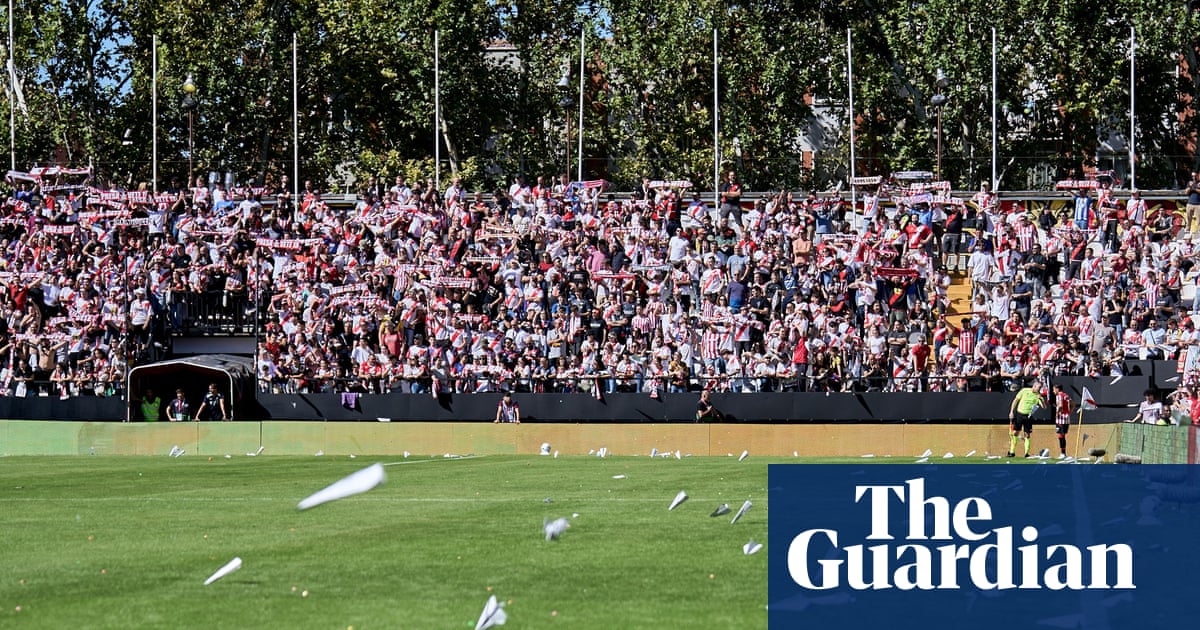
Fans of Rayo Vallecano throw paper planes in protest against their club’s chair, Raúl Martín Presa, during the match against Athletic Club, which was eventually abandoned. Photograph: Ángel Pérez Meca/AFP7/Shutterstock
Long-awaited return to Vallecas lasted just 13 minutes, as supporters made their displeasure with their chair, Raúl Martín Presa, impossible to ignore
It took 147 days for Rayo Vallecano to walk out for a competitive game on the Avenida de Albufera and 24 minutes and 56 seconds for them to walk off again. Half of those had been spent watching thousands of paper planes touch down on the turf, play suspended while a message was delivered, over and over, until it was impossible to avoid.
Forced from their home, the team from the barrio had been away for five months. On the bright Saturday afternoon that they came back, there were just 13 minutes of football, a fans’ protest instead forcing the abandonment of their match with Athletic Club, the latest episode in a never-ending story.
The last time there had been a league game here was a victory over Villarreal in May. A lot has happened since: little Rayo, Rayo Vallecano, had played a European final, 11,000 fans heading to Leipzig where, as the banner perfectly put it, they knew no greater victory than being with you in defeat. Iñigo Pérez, the manager who took them there, had departed.
And Óscar Trejo, the man who gave up the armband over treatment of staff – the best thing he could do as captain was to stop being captain – had retired and been immortalised the way the barrio does best: in graffiti four storeys high. Then, in late July, the Madrid government suspended the agreement that allows them to use the ground in return for €81,784 (£69,094) a year.
The cup, the coach and the captain were not coming back. As a new season began, nor were any of them. Rayo’s president, Raúl Martín Presa, said he was furious with the council, locking the gates to keep their technicians out and accusing them of condemning the club to segunda. But when the report described the ground as unsafe and unhealthy, Rayo’s fans knew they were right: they had been saying so for years, relieved to be finally heard.
The ground’s upkeep was the tenants’ responsibility but – like so much else – it had been abandoned, left to ruin. They were furious with the president they believe condemns them to a fate far worse that relegation, a man they could not despise more and who despises them back, of whom they ask just one thing, as often as they can: for him to leave.
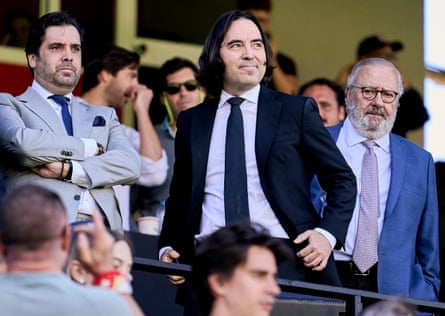
Talk of the town: Raúl Martín Presa (centre) was all smiles despite the protests against him. Photograph: Europa Press Sports/Europa Press/Getty Images
They are not alone. Last season players had complained about conditions, forced to train at Getafe and play at Leganés; as the new season began they would have to do so again. After a long summer and three home games played 20km south, where 4,280, 4,529, and 3,742 came to see Alavés, Racing and Espanyol, respectively – collectively fewer than in a single afternoon in Vallecas – they were finally back.
Leganés had been left three-quarters empty, boycotted by supporters, but in football terms it had been good to them, which sums Rayo up: all wrong but somehow all right. Last season’s victory over Atlético there was followed up by two wins and a draw this season.
Yet this is home. Besides, down at Rayo, in the heart of the self-styled independent republic of Vallekas, the football is the least of it, striker Sergio Camello says; it’s about what they stand for. And this weekend they were going to make another stand.
They could not have chosen a better opponent: Athletic’s fans are allies, supporters packed into the bars around the ground and the plaza in front of the Mercado de Numancia alongside Rayo’s fans, singing in the sunshine. The protest had been planned from the start; what they probably did not plan for was the way it ended.
On surfaces all around the stadium, green stickers proclaimed “SOS Rayo Vallecano”. Presa’s image appeared on walls and scarves with familiar Mickey Mouse ears. From bags they handed out little plastic balls in many colours. And from boxes they handed out flyers.
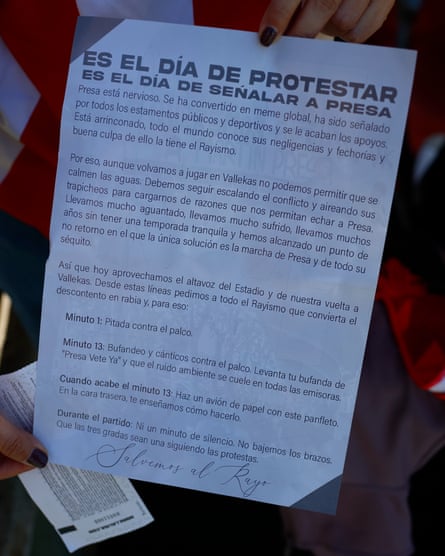
‘It is the day to protest. It is the day to single out Presa.’ One of hundreds of protest flyers that eventually became a paper plane. Photograph: MARISCAL/EPA
Printed on grey A4, the sheets declared: “Today is a day to protest.” After “years of putting up with this”, they had reached a “point of no return”. And so, in the 13th minute, everyone was invited to chant “Presa, go now!” Then to turn the paper into a plane and fly it on to the field. On the back of the sheet were handy, Ikea-style instructions for those who did not know how to fold a paper plane.
An Athletic corner arrived with perfect timing, setting it all up. The whistles started bang on the 13th minute and so did the planes, swooping in from all three stands. The referee, José María Sánchez Martínez, stopped the game and shrugged, which he did a lot.
Small, multicoloured plastic balls came down too, bouncing and rolling across the pitch, while a banner unfurled in the main stand declared the ball in Presa’s court (which is precisely their problem). An announcement was made, a first warning, two more strikes and they were out. For now, they would play on but not until the pitch was clear.
Ballboys dashed across, applauded all the way, to do what ballboys do: pick up the balls. Planes were pushed off the pitch. Players kicked about among themselves. And, after a pause of eight minutes and 43 seconds, Sánchez Martínez, satisfied now, sent them back over to take the corner, Pathé Ciss congratulating a ballboy on a job well done as he returned to his position.
The corner came in, Yuri Berchiche volleyed just wide, shot flashing past the post, and then the planes came down again. Two touches, strike two. This time, the referee took them off. The stadium clock had rolled on but now it was reset as they headed down the tunnel to chants of “Presa, go now!”
They had been out there 24 minutes and 56 seconds but it might as well have been half-time. In the shadows of the narrow corridor under the stand, conversations unfolded. In the sunshine, so did the tinfoil, supporters happily eating the sandwiches meant for the break.
Half an hour after kick-off, there was an announcement: they would begin again in 20 minutes. And if more objects are thrown, the match would be abandoned. From the tunnel, Isi Palazón and Óscar Valentín came out to speak to fans behind the goal.
This was bad: if it happens again, the game is over. This was good, a plan forming: if it happens again, the game is over. A clear protocol, postponement easily forced, a statement made more visible, more powerful than ever before.
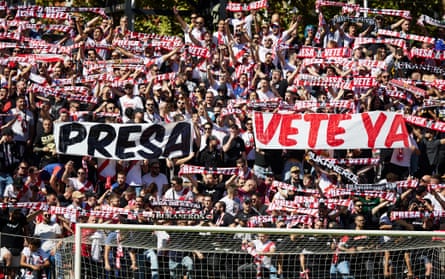
Rayo supporters protest with a banner that reads ‘Presa, go now’. Photograph: Alvaro Medranda/Quality Sport Images/Getty Images
Thirty-eight minutes and 16 seconds after kick-off, the players reappeared, Athletic first. Sánchez Martínez bounced the ball, said it is flat, swapped it over, and gave it to Emil Audero, whose goal-kick would be the new kick-off, 43 minutes since the first time.
From behind him, someone started a countdown: five, four, three … As the ball flew into the air, so did more paper planes. Sánchez Martínez shrugged, looked at the end, a hint of defiance. Leaning against his post at the other end, Unai Simón watched it all happen.
Sánchez Martínez called over the captains, then the coaches. A circle formed on the pitch: the referee, his assistant, two captains, two managers, a delegate, La Liga’s match director, the security adviser and a police officer. The Rayo coach, Beñat San José, translated for Edin Terzic, whispering in his ear.
Terzic nodded. Álvaro García argued, but there was nothing he could do. The referee’s hands were tied, the police wanted to go, and at nine minutes to three, 49 minutes and 18 seconds after the game started, he signalled towards the tunnel. They had played 13 minutes.
Kick off your evenings with the Guardian's take on the world of football

after newsletter promotion
Rayo’s players departed, Ivan Balliu first, to applause. The referee stood, hands on his hips, a disapproving parent who had sent the kids to their room. Athletic’s players went to their fans in the far corner, then back towards Rayo’s supporters, who chanted: “Athletic! Athletic!” Iñaki Williams and Simón were the last off.
They stopped for photos with the ballboys. Williams gave someone his shirt, Simón handed over his gloves. As they reached the tunnel, Williams signed someone’s shirt. As they disappeared, the stadium launched into the Vida Pirata, usually a victory song.
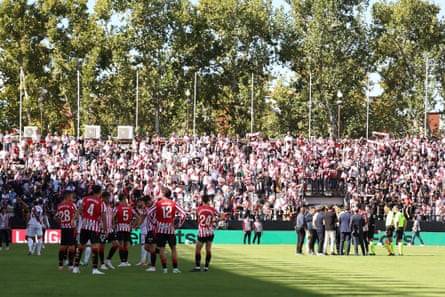
Athletic players wait on the pitch (left) as the referee makes the decision to abandon the match (right). Photograph: Florencia Tan Jun/Getty Images
They may not have won, may never win, but many wonder what they had left to lose. They were not planning to get it postponed, an opportunity opening instead, but they might next time. Presa says he will never leave, even if they fall to the third tier, but what if they do it again and again? At what point does someone step in?
The club attack the “ultras” – that old get-out clause – and call the rest of the ground “victims”, but that is not how the rest of the ground sees it, flying their paper planes and happily heading off into the afternoon. Even Athletic’s supporters, their big day out brought to an early end, were on side.
They joined Rayo fans in the bars while down in the offices, there were negotiations over when to replay the game, probably behind closed doors: Athletic wanted to return the following morning but that was rejected and so at 4.23pm on Saturday their bus pulled out for Barajas, applauded up Payaso Fofo street and right on to Avenida Albufera, still none the wiser.
Málaga 1-1 Espanyol, Rayo 0-0 Athletic (abandoned), Alavés 1-2 Atlético Madrid, Barcelona 3-0 Getafe, Real Madrid 1-0 Villarreal, Elche 0-0 Celta, Real Sociedad 3-2 Deportivo, Betis 5-2 Osasuna, Racing Santander 2-2 Valencia
Monday: Levante v Sevilla (8pm BST)
Rayo’s supporters’ association called this “the inevitable consequence of exhaustion, frustration and anger” after “15 years of abandonment of the facilities, chaotic management, a loss of identity and a continuous contempt for employees and fans, as well as the club and its values”. They called Presa “dictatorial”; the protest, by contrast, “peaceful and democratic, necessary”.
“An unsustainable situation has reached its limit,” the captain Valentín posts. “This has got worse and worse bit by bit for too long without anyone doing anything to stop it getting this far. We have to listen to and understand the fans’ discontent. We need to find a way to bring everyone together for the common good and the good of Rayo Vallecano above all. That’s the only way we will ever live great moments together again.”
Artikel av The Guardian. GoalingBreak visar texten för enklare läsning: alla rättigheter tillhör utgivaren.
Läs originalet →